Rahanis Before the Park
David W. Runyan II, August 19, 2017
This piece presents a mixture of history and childhood memories about a place in Burlington, Massachusetts called Rahanis Park. The town created the park after seizing private property in probate court following the death of the owner and in a show of pretentious courtesy named the park after him.
The wonder of this place is not in the park but in the Rahanis. The story behind the story is the real story; the history of the land, the man who owned and worked the land, and the enchantment of that land in the few years between his death and the town's destruction of his private property.
Before delving into my pre-park chronicle, allow me to fill you in as best as I'm able regarding the man who owned this place which was such an important part of my childhood that I spent significant amounts of time researching him only to discover that precious little about him is known, remembered or documented, but what little I've discovered I now share.
His name was Stylianos Rahanis. He was an immigrant from Turkey who came to the United States as a young man. He served in the First World War, worked as a machinist in Boston, then abandoned the city to be a pig farmer in rural/agricultural Burlington where in the early 1930s he purchased about 50 acres of land on Mill Street at the corner of Skilton Lane. He died at home of a heart attack in September, 1962 and his wife remained in the house until 1963. She was reported to be in poor health and moved into a nursing or senior home. They had no children, Stylianos had no relatives living in the US, he died intestate and it is rumored that some back taxes were owed. So the town moved to seize the land according to its bylaws and after becoming the new owner of the property, decided to convert most of it into a public park and subdivide a few lots for homes at the end of what was then Fox Hill Road but has since been renamed Patriot Drive.
My family moved into a newly built house on the corner of Skilton and Mill in early 1964. Our back yard abutted the Rahanis land; a brief strip of low bush blueberry adorned forest was the dividing line between. Mrs. Rahanis had left the property only a year earlier and the entire parcel was now an abandoned farm, complete with farmhouse. We kids of the area used this land as our frontier for exploration. In my opinion, and probably that of all kids who explored and played there, the town would have done its youth a far most satisfying service by leaving the land as it was as opposed to bulldozing it into oblivion to create one of those nondescript, cookie cutter public parks which so routinely dot the American suburban landscape.
Since I can find no photos of the Rahanis farmhouse and land, I shall now attempt using my memories and words to reconstruct the details of this place and the wondrous ways in which it impressed and thrilled us young people who were free to explore it for a few brief years which left us with fond
memories lasting a lifetime.
The most amazing feature of the land was the farmhouse itself which remained intact for about 3 years, fully furnished down to the bed spreads and window drapes. It remained this way until the town received legal authority to burn down the house and fill in the cellar hole.
The house was not locked. We kids were free to enter and enter we did and often. To we 7-10 year olds, it was a scary yet irresistible place that we invaded, ran around, imagined ghosts where chasing us and left in a hurry. To the teenagers it was a place where they drank beer and got laid. It was the domain of preteens by day and of teens by night.
The house was a typical two-story farmhouse with a cellar. Mrs. Rahanis apparently took nothing with her when she left. The kitchen table and chairs were there, the living room sofa and coffee table were there, the bedrooms had beds with pillows, sheets and bedspreads, all the windows had curtains, there were major appliances and all kinds of personal effects. The medicine cabinet in the bathroom was overflowing with prescription drugs. It was reported that Mrs. Rahanis was an ill woman and her medicine chest seems to lend credence to those reports.
The town did not board up the house and slap pad locks on the doors. In that era our nation was a functional society. The drug culture had not yet taken hold in a big way so the house was not used as a heroin hangout and because the economy was robust and costs were under control no one was homeless so there were no squatters living there. The worst thing that happened there was teenage boys having sex with teenage girls at night and drinking beer. It is true that over time a few bad apples busted a few windows but if my recollections are correct, the doors were open until the day the Burlington Fire Department torched the place.
In the front yard was a water fountain whose pedestal was made of stones and mortar. The town had not bothered to disconnect service so it was a working water fountain from which we hard-playing kids would drink at will.
Also in the front yard was a crab apple tree. The fruit was bitter so we used those apples to bop our friends when they weren't paying attention. The Rahanis land however did not leave us devoid of edible fruit. at the forest edges and along the banks of the two streams flowing thru the property were blueberries and raspberries galore from which we snacked during the summer months.
Between the apple tree and the house stood a phone pole and mounted to that pole was an old rotary telephone enclosed in a rusty steel case with a hinged door leading us to believe that the Rahanis' made their calls outside. This feature was brought to my memory by my sister Michelle after reviewing the article . . . thanks, sis!
In one part of the land, Rahanis had dug himself a personal landfill which always had water therein. Many children, this author included, learned to ice skate at that water hole by winter and come spring we navigated it upon log rafts built by a neighborhood dad. At the edge of the landfill were two rusting old VW beetles which we children faux-drove. Those are the cars which taught us the difference between the brake pedal and the clutch and also where we learned the shifting pattern of the 3-speed manual transmission.
Next to the landfill was a vernal pool where we caught polliwogs and salamanders when the snow retreated and life began anew each year. The landfill and vernal pool are now the last 3 homes on Patriot Drive. This was done before it became illegal to develop on wetlands.
Along the Mill Street frontage was a rather nicely constructed and unusually tall stone wall; not the typical fieldstone wall, but a gapless stone and mortar wall with an entry way having beautifully sculpted stone pillars.
A curious feature of the land was along the cart path between the house and the pasture. On one side were found very uniformly arrayed grass mounds and opposite them were found equally uniformly arrayed ditches. We named the one "Lump Lane"and the other "Ditch Valley". Lump lane is the present day tennis courts. Ditch Valley is now where the town keeps a tool shed.
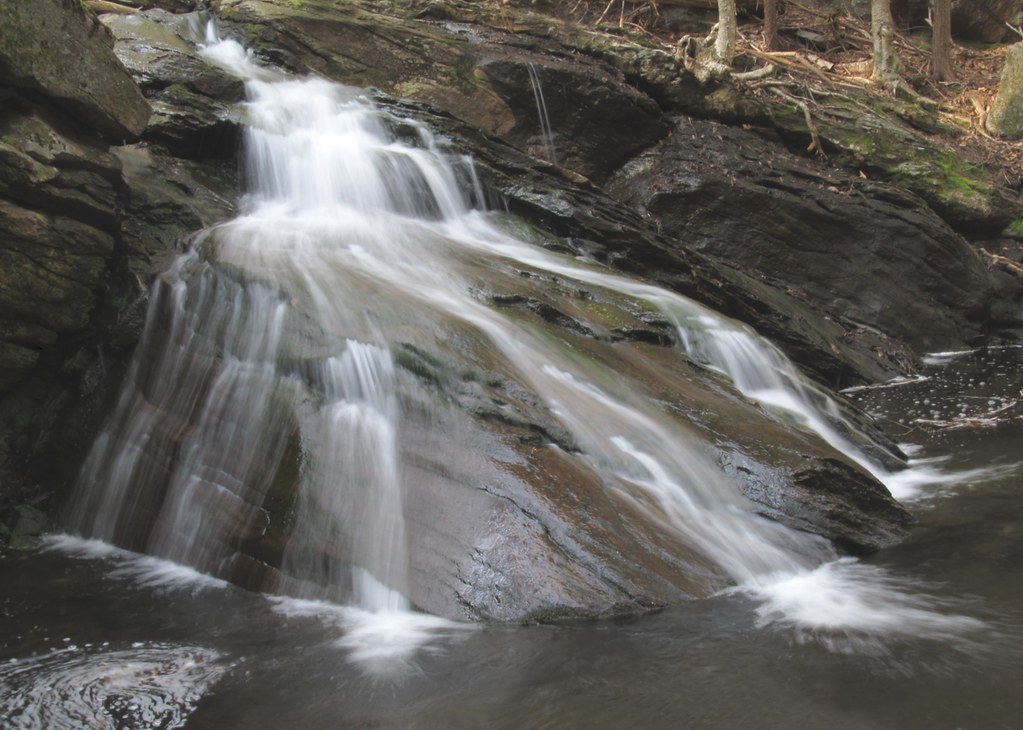
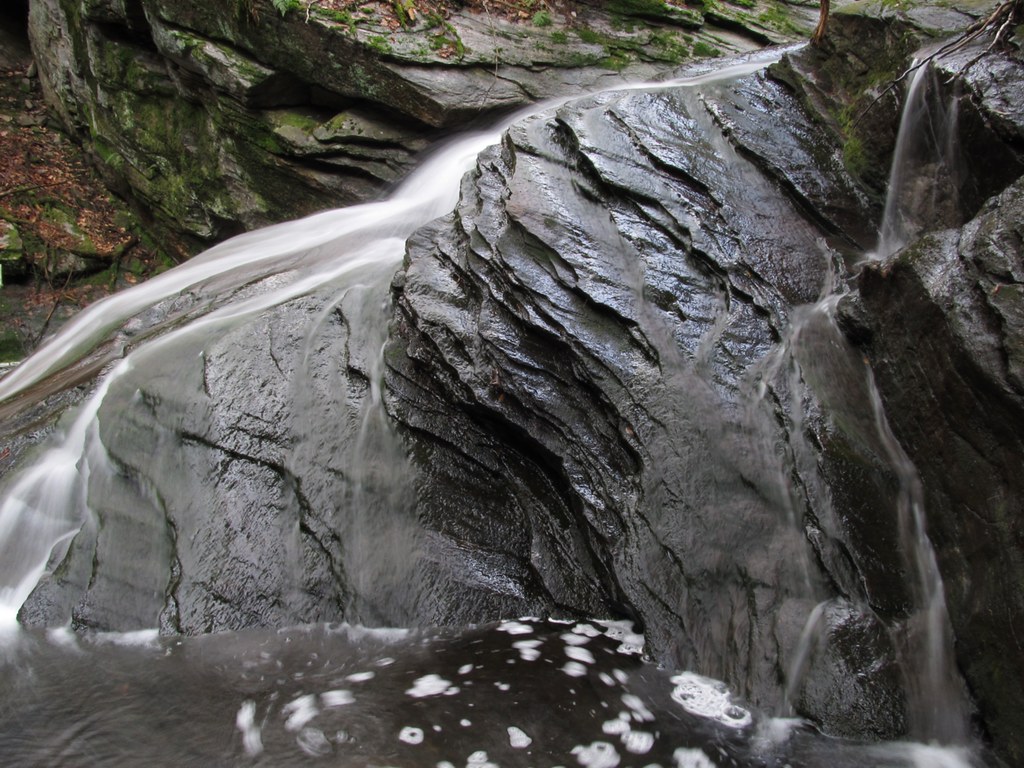
Two streams flowed through the land; one at the rear of the pasture parallel to the high tension wires and it flowed into the other, which is Sawmill Brook. These were year-round waterways both, although their flow was a trickle by August each summer. In these streams we would catch frogs, turtles and cray fish.
The pasture was open and flat. A perfect venue where we played informal neighborhood baseball and football. The pasture naturally went on to become a Babe Ruth baseball field and sometime later when Burlington was infiltrated by cosmopolitaines, it was transformed into a soccer field.
To the left of the farmhouse was a wooded area through which passed the outflow of Shaw's Pond. This stream flowed strongly only during periods of heavy rain but it trickled year round. In winter it became an amazing obstacle course ice skating rink where we learned how to make tight turns by maneuvering around the trees embedded into the ice. The present day basketball courts abut this forest and wetland.
Shaw's Pond itself was not a part of the Rahanis property but close enough that we explored it as routinely as we did the farm land. It was deep enough to fish but a unique environment that we called The Dark Pond, deeply shaded by a dense canopy of forest and this darkness prevented the survival of fish there. Even so Shaw's Pond was a great place for young kids to explore and for teens to hang out at, have a campfire and drink beer.
Another fabulous object which was not on Rahanis property but very close was the Tarzan Swing on the Sawmill Brook just beyond where the farm ended. The rope was thick, about 2" diameter as I recall and fastened to the top of a 60' tree so a trip on the swing covered alot of ground (and water). Many a young boy ended up in the drink before learning how to master the swing. It was one of our incidental neighborhood rites of passage.
It is impossible to explain the endless ways in which the raw abandoned land of Stylianos Rahanis enriched the lives of the children who freely and daily explored all that it had to offer. The incidentals of the property became memories embossed permanently within the souls of its visitors. The types
and degree of memories made there can not be obtained from a town park. If you've seen one park you've seen a billion of them. They all have swings, slides and basketball courts.
The land of Stylianos Rahanis on the other hand was a unique terrain with incidentals specific to it alone and found nowhere else on the planet. Also, a town park is a control freak environment with rules, regulations
and oversight by police, the park department and busybody mommie dearests. The Rahanis land was a place where kids were free to be kids according to their own instincts and minus the micro management of adults and authorities. In this regard it was a precious liberty.
In closing, I bring us back to Stylianos Rahanis. He was an immigrant from a Muslim nation who almost immediately upon arrival joined the US military and served his new country. While he could have continued to live a more relaxed life as a machinist in Boston, he chose instead the life of a farmer which
has always required hard work and rugged individualism. He was in many ways the textbook case of those who came to America from far away places to make a better life through their own efforts.
Though I never met the man, his land is the bedrock of my most powerful childhood memories. When he departed, his personal legacy became the treasured legacy of hundreds of children. As children, we were told that Mr. Rahanis loved kids and gave his land to them forever. That may be true, or it may also be true that the town took the land for back taxes. It makes little difference to me. Should I meet him in the Great Beyond, my first order of business will be to thank him for the immeasurable ways in which his farm decorated my childhood.
'But there's a 4-lane highway down by the creek,
where i went skinny dippin' as a child;
and a drive-in show where the meadow used to grow
and the strawberries used to grow wild.
There's a truck stop down by the riverside,
where my grandma's cow used to graze;
now the grass don't grow and the river don't flow
like it did in my childhood days.
Joe South, Don't It Make You Wanna Go Home
https://www.youtube.com/watch?v=8rtIS9kB6Go